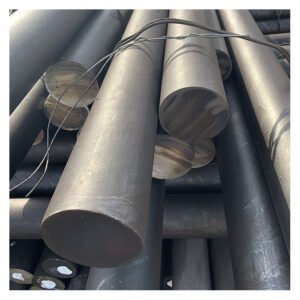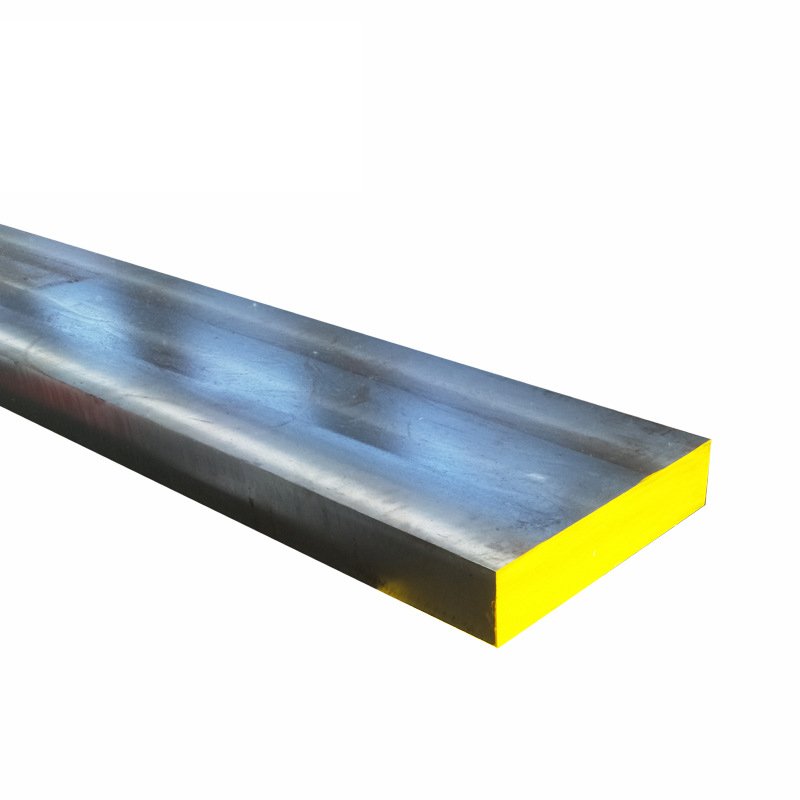
1.2344 TOOL STEEL
| Smelting and Manufacture Method: | LF+VD+ESR+Forged |
| Delivery Condition: | Annealed |
| Delivery hardness: | ≤235 HBS |
| UT Test Standard: | Sep 1921-84 Class3 D/d,E/e |
1.2344 STEEL GRADE COMPARISON AND CHEMICAL COMPOSITION COMPARISON
| Standard/Steel Grade | Chemical Composition(%) | ||||||
| C | Si | Mn | Cr | Mo | V | ||
| DIN/W-Nr. | X40CrMoV5-1/1.2344 | 0.35~0.42 | 0.90~1.20 | 0.30~0.50 | 4.80~5.50 | 1.20~1.50 | 0.90~1.15 |
| ASTM | H13 | 0.32~0.45 | 0.80~1.20 | 0.20~0.50 | 4.75~5.50 | 1.10~1.75 | 0.80~1.20 |
| JIS | SKD61 | 0.35~0.42 | 0.80~1.20 | 0.25~0.50 | 4.80~5.50 | 1.00~1.50 | 0.80~1.15 |
APPLICATION
1.2344 steel occupies a dominant position in the field of aluminum zinc die-casting molds. Its optimization can withstand repeated flushing of molten metal at 700 ℃, and its thermal fatigue resistance is improved by more than 30% compared to ordinary mold steel. It is particularly suitable for the production of complex die-casting parts such as automotive engine cylinder blocks. 1.2344 steel undergoes isotropic treatment to achieve uniform toughness in all directions, significantly reducing the risk of mold cracking.
1.2344 steel performs well in the field of plastic molds, especially suitable for injection molding of fiberglass reinforced engineering plastics. After tempering at 530-560 ℃, it has both wear resistance and polishing properties, with a surface roughness of Ra0.05 μ m. The 1.2-1.5% molybdenum content significantly reduces the wear rate of glass fibers. After nitriding treatment, the surface hardness of 1.2344 steel reaches 800-1000HV, and the friction coefficient drops below 0.3.
1.2344 steel is also widely used in the manufacturing of high-temperature cutting tools, such as continuous casting billet cutting guide wheels, steel billet hot cutting machine blades, etc. At 800 ℃, it still maintains a hardness of HRC40 or above, and the silicon content (0.8-1.2%) synergistically improves the red hardness with vanadium carbides. 1.2344 steel can accurately control the thickness of the infiltration layer by 0.1-0.3mm through ion nitriding, extending the tool life by 3-5 times.
Physical properties at 20°C
1.2344 steel heat treatment
Hardening
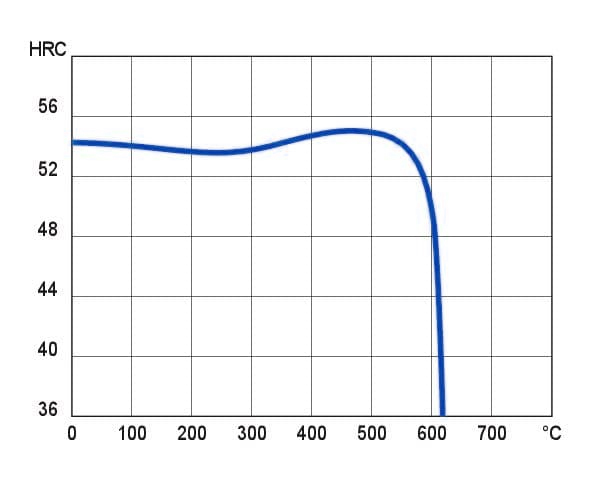
Tempering